

Last Updated on October 5, 2026
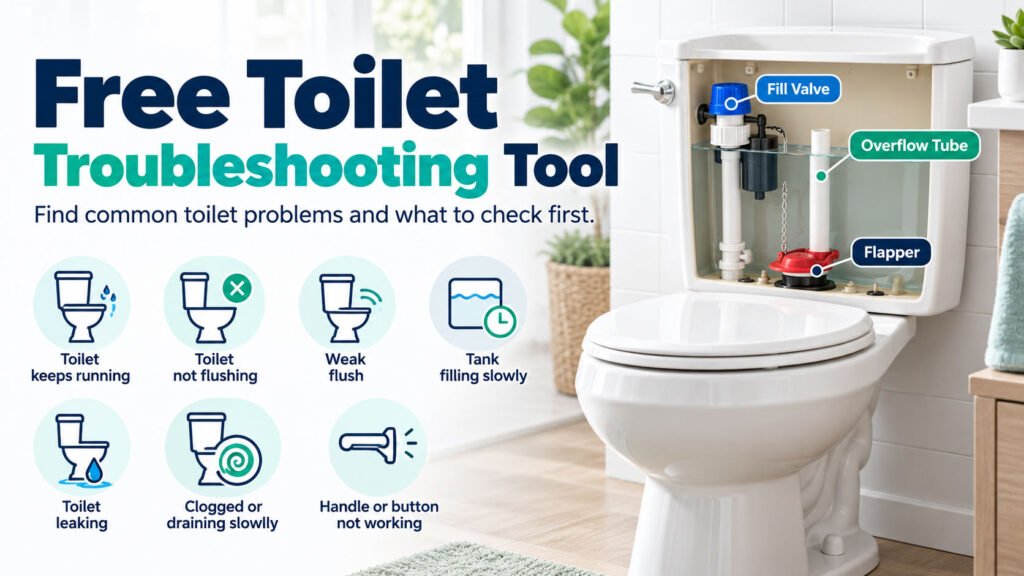
Free Toilet Troubleshooting Tool
Toilet keeps running, won't flush properly, leaks, or fills slowly? Use this free toilet troubleshooting tool to narrow down possible causes and find practical checks to try before buying a replacement part.
Choose the symptom that best matches your toilet and answer one follow-up question. You'll get a tailored checklist, clear safety advice, and links to official maintenance resources. The result is guidance—not a confirmed diagnosis.
Free Toilet Troubleshooting Tool
Find the most likely causes and what to check first—without guessing which part to buy.
How to Use This Toilet Troubleshooting Tool
- Choose a symptom. Select running, weak flushing, clogging, slow filling, leaking, handle problems, or unusual noises.
- Answer the follow-up. Pick the option that describes what you actually observe rather than guessing which part has failed.
- Read your result. Follow the recommended checks in order, pay attention to safety notices, and use the linked official documentation for your specific toilet model.
The questions are optimized for conventional, residential gravity-flush toilets. Pressure-assisted, concealed-tank and electronically controlled systems can require different procedures; consult their model-specific instructions.
Common Toilet Problems: Symptoms and First Checks
Toilet Keeps Running
A running toilet may allow water to enter its overflow tube continuously, or water may escape from the tank into the bowl through a flush seal. Those two situations call for different checks. Carefully lift an accessible tank lid and look at the water level. If water flows into the overflow tube, consult the manufacturer's fill-valve and level-adjustment instructions. If the tank refills periodically without anyone flushing, inspect the flush seal and linkage and try the dye test below.
Toilet Not Flushing or Weak Toilet Flush
If your toilet is not flushing, begin by checking what happens when you activate the handle or button. On a conventional gravity toilet, the flushing mechanism must lift or release the appropriate seal, and the tank should refill to its specified waterline. If water rises in the bowl or drains slowly, stop repeated flushing: a clog or drainage issue may be involved. KOHLER also identifies slow drainage, repeated clogs, and noises from nearby drains as possible signs of waste-stack or vent problems. These symptoms alone cannot establish which component is at fault.
Toilet Tank Filling Slowly or Not at All
Check whether other fixtures have water and whether the toilet's shutoff valve is open, without forcing a stuck valve. Look for an obvious kink or leak at the visible supply hose. A restricted fill-valve inlet or worn fill valve is another possibility; use the exact manufacturer's maintenance procedure before disassembling any water connection.
Toilet Leaking Around the Base or Tank
First dry the outside of the toilet and identify where fresh water appears. Condensation, a supply-line leak, a tank connection, and leakage at the floor connection can look similar. If water emerges around the base during flushing, avoid using the toilet until its seal and installation are evaluated. A rocking toilet or soft flooring warrants prompt attention. Do not try to conceal an active leak with caulk.
Clogged Toilet or Repeated Blockages
If the bowl water approaches the rim, don't flush again. An appropriate flange plunger may clear an ordinary single-toilet clog. Do not add chemical drain cleaners or combine products, particularly when you may need to plunge or use an auger. Repeated blockages, gurgling in other fixtures, or sewage backup require a plumber to assess the drain system.
Flush Handle or Button Problems
On models with accessible tanks, check whether the handle actually moves the lift arm, chain, or cable. A stuck chain can prevent some flush seals from closing fully. Push-button and canister systems have different linkages. Match any replacement using the exact manufacturer and model instead of relying on appearance alone.
How to Check for a Silent Toilet Leak
The U.S. EPA WaterSense home-maintenance guidance recommends checking for silent toilet leaks with a simple dye test:
- Carefully open the tank of a conventional toilet.
- Add a few drops of food coloring or a toilet leak-detection dye tablet to the tank water.
- Wait 10 minutes without flushing.
- If colored water appears in the bowl, water is leaking from the tank into the bowl.
- Flush promptly after the test to help avoid staining.
Often the flapper or other flush-valve seal needs attention, but the dye test does not identify the exact faulty component. Check the specific model's parts diagram before replacing anything.
When to Stop Troubleshooting and Call a Plumber
For routine problems, simple checks may be enough to narrow down the cause. However, don't force fittings, overtighten tank bolts, dismantle pressure-assisted components, or work on electrical mechanisms without the product's service instructions.
Toilet Troubleshooting FAQ
Why does my toilet keep running after flushing?
Possible causes include water spilling into the overflow tube, fill-valve debris or malfunction, or a flush seal that does not close properly. The water level and dye test can help distinguish these possibilities.
Why does the toilet bowl fill up but not flush?
A blockage in the toilet trap or downstream drain is one possibility. Stop flushing if water rises toward the rim. Repeated slow drainage or other affected fixtures can indicate a wider drainage issue requiring professional inspection.
How can I tell if a toilet flapper is leaking?
Use the EPA's 10-minute dye test. Color appearing in the bowl without flushing indicates a tank-to-bowl leak. The flapper, canister seal, or flush-valve sealing surfaces should then be inspected based on the exact toilet design.
Can I fix a weak flush without replacing the toilet?
Sometimes. The cause may involve the water level, flushing linkage, a partial obstruction or drainage/venting. Check those possibilities before considering an entire toilet replacement.
Why does my toilet take so long to refill?
Restricted supply flow, a kinked hose, sediment at the fill-valve inlet, or a malfunctioning valve may be responsible. Don't force a stuck shutoff valve, and use model-specific instructions before opening connections.
Is a running toilet wasting water even if the floor stays dry?
Yes. A leaking flush seal can move water directly from the tank to the bowl without making a puddle. EPA recommends regular checks for silent leaks.
How do I know which replacement part fits my toilet?
Find the manufacturer and exact model number, then use its official parts diagram or product support service. Flappers, canister seals, and fill valves are not universally interchangeable.
Official Sources and Editorial Notes
This guide uses publicly available water-conservation and manufacturer troubleshooting information. Sources explain general symptoms and procedures; they do not verify an individual user's diagnosis.
- U.S. EPA WaterSense — Home Maintenance (silent-leak testing and routine checks)
- U.S. EPA WaterSense — Fix a Leak Week (leak identification and conservation)
- KOHLER Assist — Constantly Leaking or Running (fill valve, water level and trip lever)
- KOHLER Assist — Poor Flush (flushing symptoms and possible drain/vent issues)
- American Standard — Product Support (model-specific instructions)
For educational use. Troubleshooting results are symptom-based and cannot replace an inspection by a qualified plumber. This independent guide is not affiliated with or endorsed by the manufacturers listed above.
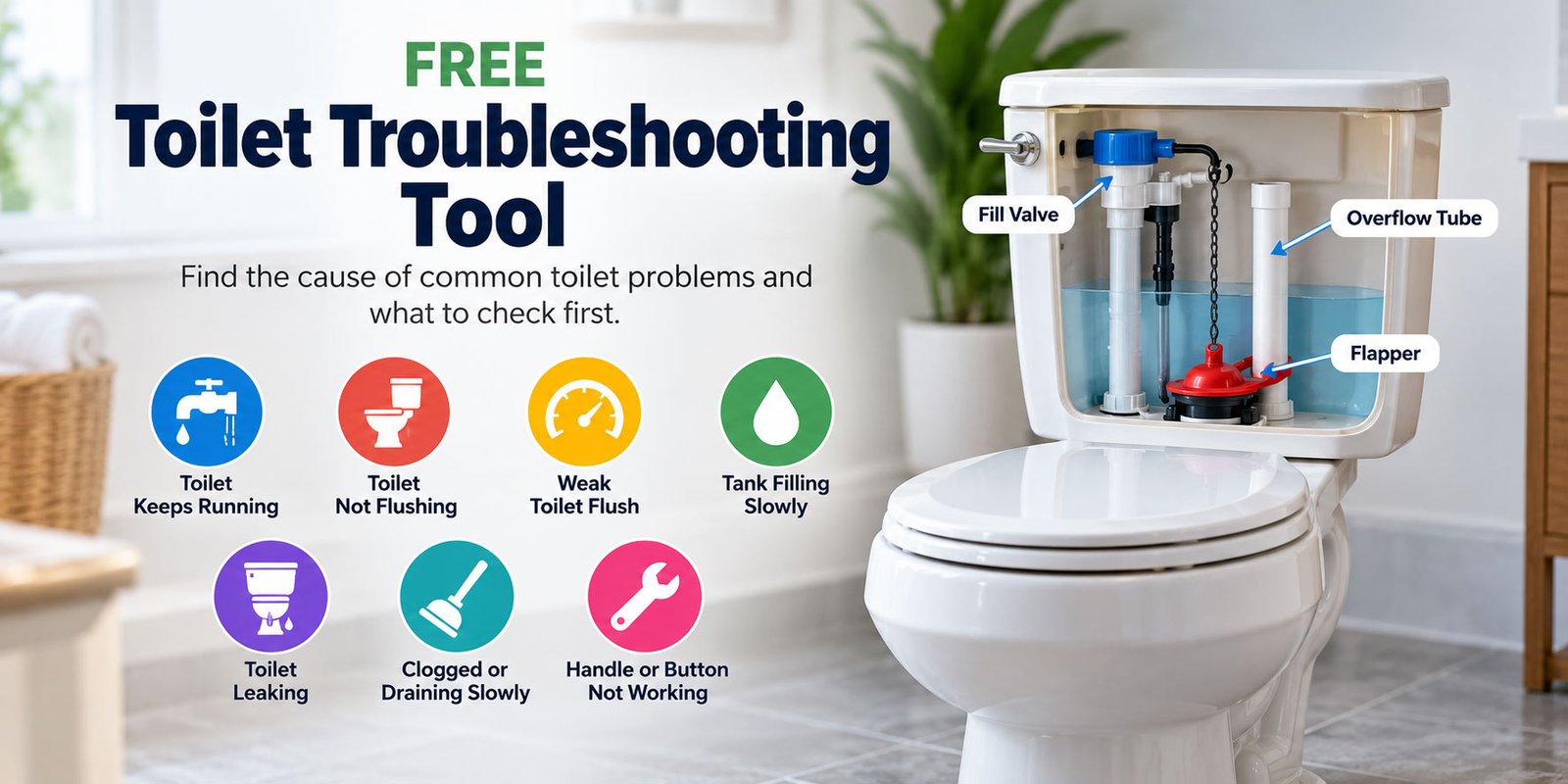
Toilet keeps running, won’t flush properly, leaks, or takes too long to refill? The problem could be a worn flush seal, a fill valve issue, an incorrect tank water level, or a blockage.
Our free toilet troubleshooting tool helps you narrow down possible causes before spending money on replacement parts or calling a plumber.
Select your problem below, answer a quick question, and find out what to check first. The results provide troubleshooting guidance rather than a confirmed diagnosis.
Safety first: If your toilet is overflowing, stop flushing. If you can safely reach the shutoff valve, turn off the water supply. For sewage backups or uncontrolled leaks, contact a qualified plumber.
How to Use This Toilet Troubleshooting Tool
Getting started is simple, and you don’t need any plumbing experience.
Step 1: Choose your toilet problem.
Select the symptom that best matches what you’re experiencing, such as a running toilet, weak flush, slow refill, clog, leak, handle problem, or unusual noise.
Step 2: Answer the follow-up question.
Choose the answer that describes what you actually observe. You don’t need to guess which component has failed.
Step 3: Review your troubleshooting results.
The tool will identify possible causes and recommend practical checks. Follow the steps in order and refer to your toilet manufacturer’s instructions before making adjustments.
This tool is primarily designed for conventional residential gravity-flush toilets. Pressure-assisted, electronic, smart, and concealed-tank toilets may require different troubleshooting procedures.
Common Toilet Problems and What to Check First
Many toilet problems produce similar symptoms. Knowing whether the issue involves the tank, flush mechanism, water supply, or drainage system can help you avoid replacing parts unnecessarily.
1. Toilet Keeps Running After Flushing
A toilet that continues running after a flush may be losing water through the overflow tube or through a flush valve that isn’t sealing properly.
Start by carefully removing the tank lid if your toilet has an accessible tank.
Look at the water level.
If water continuously flows into the overflow tube, the fill valve may not be shutting off correctly, or the tank water level may be set too high.
If the water remains below the overflow opening but the toilet refills periodically without being flushed, a leaking flapper, canister seal, or another internal leak is possible.
A chain that’s too tight or caught on another component can also prevent certain flush valves from closing properly.
What to check first: Look at the overflow tube and water level before purchasing a new flapper or fill valve.
KOHLER’s troubleshooting guidance also identifies debris in the fill valve, incorrect water levels, and trip-lever problems as possible causes of continuous running.
2. Toilet Not Flushing Properly
If your toilet won’t flush, pay attention to what happens when you press the handle or flush button.
Does nothing happen? Does the tank release water but fail to clear the bowl? Or does the bowl water rise unusually high?
These symptoms suggest different possible problems.
If the handle moves without activating the flush mechanism, the linkage, chain, cable, or button assembly may need attention.
If the mechanism operates but very little water enters the bowl, check the tank water level and flushing components according to the manufacturer’s instructions.
If water rises in the bowl and drains slowly, a clog or drainage restriction is possible.
What to check first: Determine whether the tank mechanism is operating normally or the bowl is having difficulty draining.
Never repeatedly flush a toilet when the water is already approaching the rim.
3. Weak Toilet Flush
A weak toilet flush doesn’t automatically mean the toilet needs replacing.
Insufficient tank water, a flush mechanism that doesn’t operate correctly, mineral deposits restricting water flow, or a partial blockage may affect flushing performance.
For conventional gravity toilets, start by checking that the tank reaches its manufacturer-specified water level.
Watch whether the flush mechanism opens correctly during a normal flush, but only when it is safe to do so.
If the bowl drains unusually slowly, consider a partial obstruction rather than immediately blaming the fill valve or flush seal.
What to check first: Check the tank water level, flush operation, and signs of restricted drainage.
If your toilet fills with water and then drains slowly, read our guide to slow-draining toilets for a closer look at possible causes.
4. Toilet Tank Filling Slowly or Not Filling
A toilet that takes an unusually long time to refill may have restricted water flow or a problem with its fill valve.
First, check whether other bathroom fixtures are receiving water normally.
Next, check whether the toilet’s shutoff valve is open. Never force a valve that is stuck or corroded.
Inspect the visible supply hose for kinks, damage, or leaks.
If the water supply appears normal, sediment or debris inside the fill-valve assembly may be restricting flow. KOHLER’s maintenance information identifies supply restrictions and fill-valve obstructions as possible causes of a long refill cycle.
What to check first: Verify the water supply before considering fill-valve replacement.
If the tank refills but little or no water comes from the refill tube, see our toilet refill tube troubleshooting guide.
Always follow your toilet manufacturer’s service instructions before disconnecting a water line or opening a fill-valve assembly.
5. Toilet Leaking Around the Base or Tank
Water on the bathroom floor doesn’t always mean the wax ring or floor seal has failed.
The moisture may be coming from condensation, a leaking supply connection, tank bolts, the tank-to-bowl gasket, or the toilet’s floor connection.
Dry the accessible exterior surfaces and surrounding floor, then observe where fresh water first appears.
If water appears only when the toilet is flushed, leakage from the floor connection is one possibility, but the source still needs to be confirmed.
A toilet that rocks, has cracked porcelain, or sits over soft or damaged flooring deserves prompt professional attention.
What to check first: Identify where the water originates rather than immediately replacing the wax ring.
Do not use caulk to hide an active leak, and avoid using the toilet if wastewater may be escaping around its base.
6. Toilet Clogged or Draining Slowly
A clogged toilet may drain slowly, fail to clear waste, or allow water to rise toward the rim.
Common causes include excessive toilet paper, inappropriate items entering the drain, or an obstruction in the toilet trap or connected plumbing.
For an ordinary single-toilet clog, a suitable flange plunger may help.
However, stop flushing when the water level is high. Avoid chemical drain cleaners, particularly if plunging or mechanical drain clearing may be needed.
If the problem keeps returning, or nearby sinks and tubs are also draining poorly, the obstruction may extend beyond the toilet itself.
What to check first: Determine whether only the toilet is affected or several plumbing fixtures show drainage problems.
Sewage backing up into other fixtures requires professional attention.
7. Toilet Flush Handle or Button Not Working
If pressing the handle or button doesn’t activate the flush, the problem may involve a disconnected chain, cable, lever, or another part of the flushing mechanism.
For accessible gravity-flush tanks, look for obvious disconnections or tangled components.
On toilets with flappers, a chain that is too tight can prevent a proper seal, while excessive slack can prevent adequate lifting.
However, canister, push-button, and dual-flush systems may use different mechanisms.
What to check first: Identify your toilet’s flushing system before adjusting or replacing components.
Use the exact model number to locate compatible replacement parts.
How to Check for a Silent Toilet Leak
Not every toilet leak leaves water on the bathroom floor.
Sometimes water escapes quietly from the tank into the bowl, causing the fill valve to operate periodically.
The U.S. Environmental Protection Agency recommends a simple dye test for detecting this type of leak.
EPA Toilet Dye Test
- Carefully remove the tank lid from a conventional toilet.
- Add a few drops of food coloring or a toilet leak-detection dye tablet to the tank water.
- Wait 10 minutes without flushing.
- Check the toilet bowl for colored water.
- Flush afterward to help prevent staining.
If colored water appears in the bowl without flushing, water has leaked from the tank into the bowl.
A worn flapper or canister seal is one possibility, but the test does not identify the exact faulty component.
Consult the manufacturer’s troubleshooting instructions before purchasing replacement parts.
For more information, visit the EPA WaterSense Home Maintenance guide.
When Should You Call a Plumber?
Some toilet problems can be resolved through routine maintenance or a model-specific adjustment. Others should be handled by a qualified professional.
Stop troubleshooting and seek professional assistance when:
- Sewage backs up through the toilet or other fixtures.
- Water leaks uncontrollably and the supply cannot be shut off safely.
- Water repeatedly escapes around the toilet base.
- The toilet rocks or the surrounding floor appears damaged.
- The porcelain tank or bowl is cracked.
- Multiple fixtures are draining slowly or backing up.
- Clogs repeatedly return after clearing.
Do not dismantle pressurized flushing components or electrical toilet mechanisms without the applicable service instructions.
Frequently Asked Questions
Why does my toilet keep running after flushing?
A toilet may keep running because the fill valve isn’t shutting off, the water level is too high, or a flapper or flush seal is allowing water to escape into the bowl. Inspect the overflow tube and consider a dye test to narrow down the cause.
Why does my toilet bowl fill with water but not flush?
A blockage in the toilet trap or downstream drainage system is possible. Stop flushing if the water rises toward the rim. If the problem happens repeatedly or affects other fixtures, professional drain inspection may be necessary.
How do I know if my toilet flapper is leaking?
Use the EPA’s 10-minute dye test. If colored tank water appears in the bowl without flushing, a tank-to-bowl leak is present. Check the flapper, canister seal, and related sealing surfaces according to your toilet’s design.
Can I fix a weak toilet flush without replacing the toilet?
Sometimes. A low tank water level, flushing mechanism problem, restricted water flow, or partial obstruction may be repairable. Investigate the cause before deciding that an entire replacement is necessary.
Why does my toilet take so long to refill?
Possible causes include a partially closed shutoff valve, restricted supply line, sediment inside the fill valve, or a malfunctioning fill valve. Check the accessible water supply first and follow the manufacturer’s instructions for further maintenance.
Can a running toilet increase my water bill?
Yes. Water leaking from the tank into the bowl can be wasted even when the bathroom floor remains dry. The amount depends on the leak rate and how long the problem continues.
How do I find the correct replacement toilet part?
Identify the toilet manufacturer and exact model number. Then check the manufacturer’s official parts diagram or support resources. Flappers, canister seals, and other components are not interchangeable across all toilet models.
Official Sources and Additional Resources
The troubleshooting guidance on this page is informed by publicly available information from recognized water-conservation and plumbing-product sources.
- U.S. EPA WaterSense — Home Maintenance: Toilet leak detection and household water maintenance.
- U.S. EPA WaterSense — Fix a Leak Week: Information about identifying and addressing household water leaks.
- KOHLER Assist — Toilet Constantly Leaking or Running: Troubleshooting guidance for running toilets.
- KOHLER Assist — Toilet Occasionally Leaking or Running: Information about intermittent leaks and flush seals.
- American Standard — Fill Valve Replacement Instructions: Instructions for a specified fill-valve model.
Important Note
This independent troubleshooting resource is intended for educational use. The interactive tool identifies possible causes based on reported symptoms; it does not confirm the condition of any particular toilet.
Actual repairs and adjustments depend on the manufacturer, model, and flushing system. Always consult the applicable product manual, and contact a qualified plumber when a problem involves unsafe leakage, sewage backup, structural damage, or unfamiliar equipment.
BestFlushingToilets.org is not affiliated with or endorsed by the manufacturers referenced above.

Hi, I am Jose S. Franz. Currently, I am working as a professional plumber, and our team offers various plumbing services at an affordable price. After my college education, I completed a vocational certification course in plumbing systems and worked with several construction companies. Since then, I have fixed lots of different toilet models, from older to the latest versions. So I have more than 22 years of experience installing plumbing systems and toilets in both residential and commercial buildings.