

Last Updated on October 7, 2026
Toilet Water Usage Calculator
Estimate how much water your toilet uses, what it costs, and how much you could save with a more efficient model.
How Much Water Does Your Toilet Use?
Toilets can account for a significant share of indoor household water use, especially in homes with older fixtures. The amount your toilet uses depends mainly on its gallons-per-flush rating, how often it is flushed, and how many people use it.
This toilet water usage calculator estimates daily, monthly, and yearly water use based on those factors. It can also compare your current toilet with a lower-flow replacement and estimate possible water-cost savings.
The results are estimates, not utility-bill guarantees. Actual water use can vary because of leaks, flushing habits, dual-flush behavior, and the number of days people are home.
Understanding Gallons Per Flush
The most important number in toilet water use is GPF, or gallons per flush.
A toilet marked 1.28 GPF is designed to use about 1.28 gallons during a full flush. A 1.6 GPF toilet uses more water per flush, while many older toilets use considerably more.
For estimating water savings, the U.S. Environmental Protection Agency uses the following approximate values:
- Toilets installed before 1980: about 5.0 GPF
- Toilets installed from 1980 through 1994: about 3.5 GPF
- Toilets installed after 1994: about 1.6 GPF
- WaterSense labeled toilets: 1.28 GPF or less
These are useful estimating values when the exact flush rating of an older toilet is unknown.
How This Toilet Water Usage Calculator Works
The basic calculation is simple:
Water used = gallons per flush × flushes per person per day × number of people × days
For example, if a four-person household uses a 1.6 GPF toilet and each person flushes about five times per day:
1.6 × 5 × 4 = 32 gallons per day
Over a full year, that would be roughly:
32 × 365 = 11,680 gallons
The calculator improves on that basic formula by also allowing you to account for:
- time spent away from home,
- multiple toilets sharing household use,
- dual-flush toilets,
- local water and sewer rates,
- replacement toilet efficiency,
- rebates,
- and replacement cost.
Why We Use 5.05 Flushes Per Person Per Day
EPA’s WaterSense savings calculator assumes an average of 5.05 flushes per person per day when estimating household toilet water use.
That is why 5.05 is used as the default value in this calculator.
You can change the number if your household uses the toilet more or less often.
For example, someone who works away from home most of the day may flush less frequently at home, while a household with young children or people who stay home during the day may use the toilet more often.
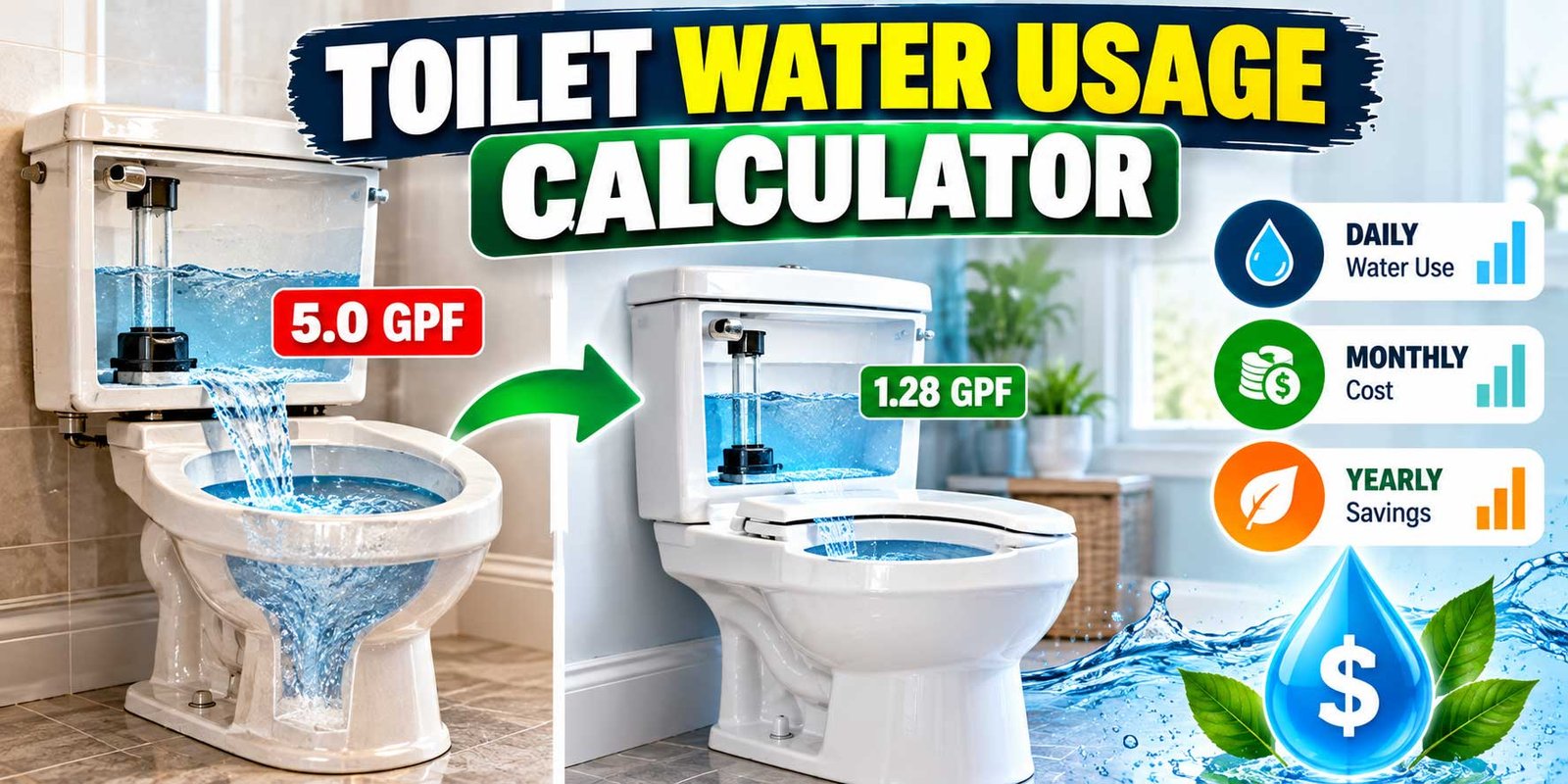
1.28 GPF vs. 1.6 GPF Toilets
A 1.28 GPF toilet uses about 20% less water per flush than a 1.6 GPF toilet.
That difference may seem small for a single flush, but it can add up over thousands of flushes.
A four-person household flushing 5.05 times per person per day would generate approximately 7,373 flushes per year.
At 1.6 GPF, those flushes would use about:
11,797 gallons per year
At 1.28 GPF, the same number of flushes would use about:
9,438 gallons per year
That is a difference of roughly 2,359 gallons per year before accounting for leaks or changes in household behavior.
How Much Water Can a WaterSense Toilet Save?
EPA reports that replacing older, inefficient toilets with WaterSense labeled models can reduce toilet water use by approximately 20% to 60%, depending on the toilet being replaced.
For an average family replacing old, inefficient toilets, EPA estimates potential savings of nearly 13,000 gallons per year and more than $170 per year in water costs.
Those figures are national examples, not guaranteed savings for every home.
Your actual savings depend on:
- your existing toilet’s flush volume,
- number of people in the household,
- actual flush frequency,
- local water and sewer rates,
- and whether the existing toilet leaks.
Use the calculator above for a household-specific estimate.
What If I Have More Than One Toilet?
Having three toilets in a house does not automatically mean your household uses three times as much toilet water.
The same household flushes are usually spread among those toilets.
That is why this calculator includes a share of household flushes setting.
For example, if your master-bathroom toilet handles about half of your household’s flushes, enter approximately 50%.
This gives a more realistic estimate than multiplying household flushes by the number of toilets.
How Dual-Flush Toilet Water Use Is Calculated
Dual-flush toilets use different amounts of water depending on which flush mode is selected.
Instead of treating every flush as the full-flush volume, this calculator can calculate a weighted average.
For example, suppose a dual-flush toilet uses:
- 0.8 gallons for reduced flushes
- 1.28 gallons for full flushes
If 70% of flushes use the reduced mode and 30% use the full mode, the estimated average is:
(0.8 × 0.70) + (1.28 × 0.30) = 0.944 gallons per flush
Actual savings depend on how people use the two flush options.
How to Find Your Toilet’s GPF Rating
Before estimating water use, look for the toilet’s rated flush volume.
Possible locations include:
- printed markings near the bowl or tank,
- a label inside the tank,
- the model number,
- the manufacturer’s specification sheet,
- or the product manual.
Common markings include:
1.28 GPF / 4.8 LPF
or
1.6 GPF / 6.0 LPF
If you cannot find the exact rating, use the approximate age-based values in the calculator as an estimate.
Can a Running Toilet Use More Water Than the Calculator Shows?
Yes.
The calculator assumes normal flushing operation.
A leaking flapper, flush seal, fill valve, or overflow problem can allow water to move continuously from the tank into the bowl.
That additional water is not included in normal GPF calculations.
If the toilet refills by itself, runs between flushes, or you hear water when nobody is using it, investigate the leak before relying on a normal-use estimate.
EPA recommends checking toilets for silent leaks as part of household water maintenance.
How Water and Sewer Rates Affect the Savings
Your utility bill may include more than the cost of incoming water.
Many households are also charged for wastewater or sewer service.
If your utility charges both based on water consumption, reducing toilet water use may affect both portions of the bill.
For the most accurate estimate, use the combined water and sewer rate shown on your utility bill.
EPA’s national WaterSense calculator uses an assumed rate of $6.06 per 1,000 gallons for its estimates, but actual local rates can be substantially higher or lower.
Should You Replace a 1.6 GPF Toilet Just to Save Water?
Not necessarily.
A well-functioning 1.6 GPF toilet may already use much less water than an older 3.5 or 5 GPF toilet.
Replacing it with a 1.28 GPF model can still save water, but the financial payback may take longer.
That is why the calculator includes:
- estimated annual savings,
- replacement cost,
- rebate amount,
- and simple payback period.
If your existing toilet is already efficient and works well, replacement may make more sense during a renovation or when the fixture develops other problems.
Frequently Asked Questions
How many gallons of water does a toilet use per flush?
It depends on the toilet. Modern models commonly use 1.28 or 1.6 gallons per flush. Older toilets may use approximately 3.5 or even 5 gallons per flush.
How much water does a toilet use per day?
Multiply the toilet’s GPF by the total number of flushes per day.
For example, a 1.28 GPF toilet used 20 times per day would use about 25.6 gallons per day.
How much water does a toilet use per year?
Multiply daily toilet water use by the number of days the toilet is used.
A household using 30 gallons per day for toilet flushing would use roughly 10,950 gallons per year.
How many times does the average person flush a toilet per day?
EPA’s WaterSense calculator uses an average assumption of 5.05 flushes per person per day for toilet water-saving estimates.
Is 1.28 GPF better than 1.6 GPF?
From a water-efficiency standpoint, 1.28 GPF uses less water per flush.
WaterSense labeled tank-type toilets must meet EPA efficiency and performance requirements, not just water-use limits.
Do WaterSense toilets flush well?
WaterSense certification includes performance requirements as well as water-efficiency requirements. A qualifying tank-type toilet must meet EPA criteria for both water use and flushing performance.
How much money can a low-flow toilet save?
Savings depend on what the new toilet replaces, household flush frequency, and utility rates.
Replacing a 5 GPF toilet with a 1.28 GPF toilet can save far more water than replacing a 1.6 GPF toilet.
Use the calculator above with your actual utility rate for a better estimate.
Does a dual-flush toilet always save more water?
Not necessarily.
Savings depend on the reduced- and full-flush volumes and how often each mode is used.
A well-designed dual-flush toilet can reduce average water use when people regularly use the lower-volume flush for liquid waste.
Why is my toilet using more water than expected?
Possible reasons include a leaking flapper or flush seal, an incorrectly adjusted fill valve, water flowing into the overflow tube, unusually frequent flushing, or an inaccurate GPF assumption.
If the toilet runs when nobody is using it, check for leaks.
Official Sources and Methodology
The calculator and supporting information on this page use publicly available information from the U.S. Environmental Protection Agency’s WaterSense program.
EPA states that WaterSense labeled toilets use 1.28 gallons per flush or less and that this represents approximately 20% less water than the 1.6 GPF federal standard.
EPA’s WaterSense calculator also uses the following estimating assumptions:
- 5.0 GPF for toilets installed before 1980
- 3.5 GPF for toilets installed between 1980 and 1994
- 1.6 GPF for toilets installed after 1994
- 1.28 GPF or less for WaterSense labeled toilets
- 5.05 flushes per person per day
WaterSense labeled toilets are independently certified for efficiency and flushing performance.
Official References
- U.S. EPA WaterSense — Residential Toilets
https://www.epa.gov/watersense/residential-toilets - U.S. EPA WaterSense — How the WaterSense Calculator Works
https://www.epa.gov/watersense/how-watersense-calculator-works - U.S. EPA WaterSense — Product Specifications
https://www.epa.gov/watersense/product-specifications - U.S. EPA WaterSense — WaterSense Specification for Tank-Type Toilets
https://www.epa.gov/watersense/residential-toilets
Important Note
This calculator provides estimates for planning and comparison purposes.
Actual toilet water consumption can differ because of fixture condition, water pressure, dual-flush behavior, leaks, household habits, and manufacturer-specific design.
For exact fixture specifications, verify the toilet’s model number and consult the manufacturer’s documentation. For utility-cost estimates, use the water and sewer rates shown on your own bill.

Hi, I am Jose S. Franz. Currently, I am working as a professional plumber, and our team offers various plumbing services at an affordable price. After my college education, I completed a vocational certification course in plumbing systems and worked with several construction companies. Since then, I have fixed lots of different toilet models, from older to the latest versions. So I have more than 22 years of experience installing plumbing systems and toilets in both residential and commercial buildings.