

Last Updated on October 7, 2026
Toilet Rough-In Calculator
Measure once, compare 10", 12" and 14" sizes, and check your bathroom clearance—all in one place.
What type of toilet?
Enter your measurement
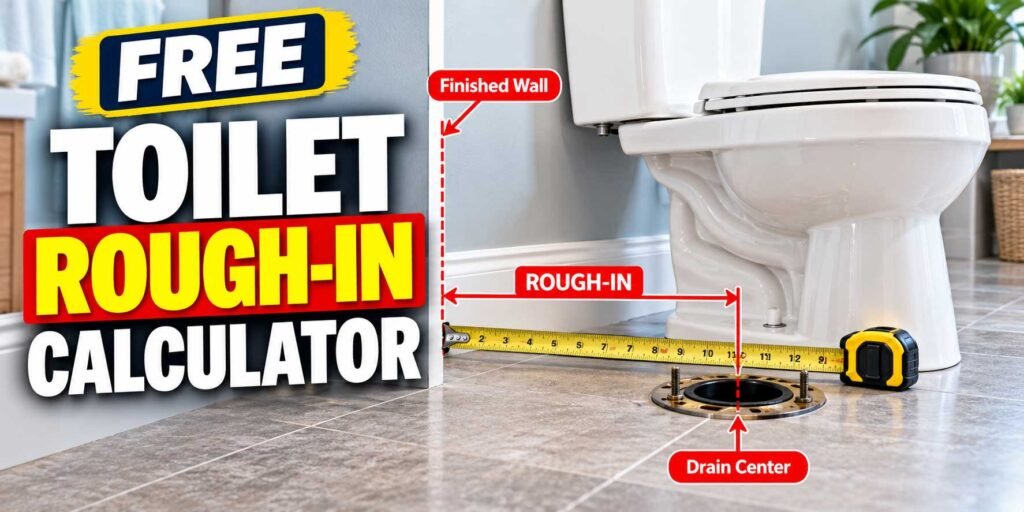
Measure horizontally from the finished wall surface (not the baseboard) to the center of the floor drain/flange, or the center of a mounting bolt on many installed conventional toilets.
We add this projection to your baseboard-to-center measurement. If unknown, measure again from the finished wall above the trim.
Optional: Check room clearance
Use the expected position of the new toilet. For front clearance, measure from the front edge of the proposed toilet to the nearest wall, fixture or door. Do not substitute the distance from the flange.
Floor-bolt rough-in calculations do not apply. Check the manufacturer's in-wall carrier, framing/stud depth, carrier height and waste outlet installation drawings for your exact model. KOHLER notes that wall-hung systems must match wall stud dimensions.
Read KOHLER's official guide ↗Enter a distance and select Check my measurements to see the nearest common rough-in category, next steps and optional space checks.
How to Measure Toilet Rough-In Correctly
For a standard floor-mounted toilet, measure from the finished wall behind the toilet to the center of the floor flange. If the old toilet is still installed, many conventional toilets let you measure to the center of a closet bolt; verify the model's arrangement if the bolts are concealed or offset. Do not measure from a baseboard or decorative molding.
10-Inch vs. 12-Inch vs. 14-Inch Rough-In
The most common residential rough-in is 12 inches, while 10-inch and 14-inch models are also available. These are nominal installation categories, not guaranteed tolerances. The exact toilet model, tank-to-wall clearance, adapter requirements and other dimensions determine fit.
Will a 12-Inch Toilet Fit an 11-Inch Rough-In?
Not necessarily. An 11-inch measurement does not establish compatibility with a 12-inch toilet. Consult the official specification drawing, confirm the actual finished-wall measurement and consider a model expressly designed for the space. Do not assume a universal offset or adapter will work.
Bathroom Clearance Requirements
Section 405.3.1 of the 2024 International Plumbing Code (IPC) generally calls for at least 15 inches from the toilet centerline to a side wall or obstruction and at least 21 inches of unobstructed space in front. Adjacent fixtures and accessible installations have additional rules. Your jurisdiction may adopt a different code or amend these requirements; the calculator is a reference, not a permit approval.
Frequently Asked Questions
Do I measure from the drywall or baseboard?
Measure from the finished wall surface, not the protruding baseboard. If you measured from the baseboard, add its measured projection to the distance—but remeasuring directly is more reliable.
Is rough-in the same as toilet depth?
No. Rough-in is the wall-to-drain-center distance. Toilet depth is the product's overall front-to-back dimension. Both can affect whether a bathroom layout works.
Can TOTO toilets use a different rough-in adapter?
Some specific TOTO toilets support optional 10-inch or 14-inch UniFit adapters alongside a standard 12-inch configuration. This is model-dependent; check the exact model and adapter part number.
What if I measure 11.5 inches?
Recheck from the finished wall to the true flange center, then consult the selected toilet's installation drawing. A rounded reading alone cannot confirm a 12-inch model fits.
How much space do I need in front of a toilet?
The 2024 IPC's general reference is 21 inches from the toilet's front edge to the nearest wall, fixture or door. Verify your local code and any accessibility requirements.
Official References
- KOHLER — Toilet Buying Guide
- American Standard — Finished-wall measurement definition
- TOTO — Example with optional 10/14-inch rough-in
- ICC — 2024 IPC Section 405.3.1
Important: A rough-in size is NOT a product-fit certification. Educational guidance only. This tool does not certify fit or code compliance. Verify model-specific installation drawings and applicable local rules before purchasing or installing a toilet.

Hi, I am Jose S. Franz. Currently, I am working as a professional plumber, and our team offers various plumbing services at an affordable price. After my college education, I completed a vocational certification course in plumbing systems and worked with several construction companies. Since then, I have fixed lots of different toilet models, from older to the latest versions. So I have more than 22 years of experience installing plumbing systems and toilets in both residential and commercial buildings.